
What Goes into a Roofing Quote
There are dozens of variables that influence the requirements and price of roofing. A good contractor will walk you through the options but comparing expectations with technical specifications can be challenging. In this article we help readers understand how variations in system configurations affect contractor rates and how wide swings in contractor pricing identify performance concerns.
Type of Project
Industry outlines two basic types for roofing projects. An overlay is the installation of a new roof system over an existing roof and ‘tear-off’ is the complete removal and replacement of existing roof(s).
Building codes define whether owners can resurface or overlay an existing roof and when previous roof systems must be removed (tear-off). Regulatory requirements are intended to avoid a roof collapse by assuring substrates can support additional weight.
More importantly, removal of previous roof systems facilitates inspection of the substrate for deterioration. This is essential if the roof has a history of leaks, low areas holding moisture, soft decks and substrates that don’t properly disperse water towards drainage.
Deck deficiencies that collect moisture over night are considered obvious points of failure. Membrane wear due to moisture leads to weather related penetration but waterproofing and insulation previously infiltrated by moisture may appear to leak to lesser degree on sunny days.
If any of these conditions are present removal of the roof system is recommended to eliminate existing moisture, inspect the substrate and perform repairs.
Configurations & Price
At its core the expense of roofing is configured around material warranty terms or the consumers expected serviceable life for the new roof. The lowest qualifying flat roof configuration is ten years with the highest at thirty in five year steps.
The most used configuration for commercial roofing is twenty years but there are use-cases like data centers and cold storage that warrant thirty year installations.
It’s important to understand that not all brands, material configurations and related pricing are created equal. Higher quality materials can be laid down with minimum of components. However, some brands require insulation to qualify for a fifteen year or higher warranty term.
California regulations suggest any new roof system requires insulation to meet energy codes but there are a number of exceptions including local adoption. Many contractors leverage this mandate to promote materials that require insulation to qualify for an NDL warranty.
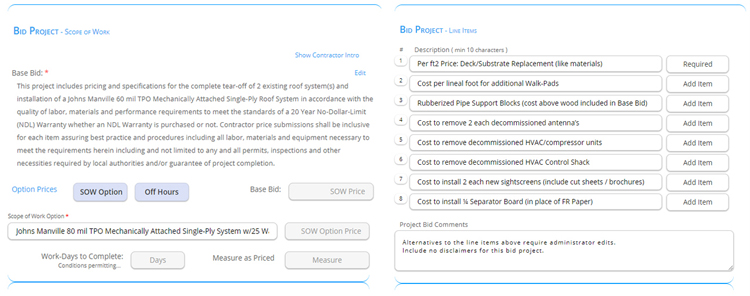
California regulators impose a considerable economic impact on property owners and tenants. New commercial roofing priced without insulation at $200,000 will cost closer to $300,000 to install with insulation. Its advisable to price insulation and other contractor recommended enhancements as line items included by all quotes. This allows the expense of enhancements and optional components to be compared individually, considered, added and/or removed from the base price (SOW) to configure a final project cost.
California and brands requiring insulation put consumers at a disadvantage if property owners and managers don’t understand the market and nuances of roofing. Not all California municipals require roofers to install insulation and the best materials don’t require insulation to guarantee performance.
Understanding material brands that require insulation to meet performance expectations is critical to the bottom line. Brand A with insulation should always price higher than Brand B without but price doesn’t guarantee equivalent waterproofing protection or material performance.
NDL Warranty
A no dollar limit (NDL) warranty isn’t always the savior many believe. An NDL may do more to protect material manufacturers than building owners. First and foremost, an NDL requires annual inspections which can cost $1,500 every year.
Any claim against an NDL also requires the manufacturer to perform an additional inspection starting at $500. NDL language is a legal interpretation of what is covered by exclusion or disclaimers. They also define building owner performance requirements (ie: inspections) which can extend to the legal course that must be followed if a claim escalates.
We’ve seen language that suggest the purchase of an NDL or material warranty property owners give away certain legal rights and remedies. Some documents require arbitration in the manufactures preferred state before making a claim in court. And NDL language may be limited to material failures, only if and when a roof system actually leaks.
As with most single ply systems, we might be able to identify material failures as they manifest. But if the roof isn’t leaking yet, the NDL may not cover these manifestations. If the roof does leak, the manufacturer’s responsibility is often limited to repair of the waterproofing.
Alternatives
As CRS Roof Consultants (CRS) in San Jose, CA states, “the best warranty is one you don’t need”. This means choosing the best material and a quality contractor over the latest innovation or lowest priced configuration. In contrast, high price quotes don’t guarantee quality contractor or the best configuration.
RFQGuides developed eScope for Roofing to help buyers write bid requirements with artificial intelligence (AI). At a fraction of the cost for professional roof consultants, roofing buyers get a digital roof advisor. Basic eScope features include a written bid specification detailed for apples to apples price comparison. Contractor bid submissions are presented side-by-side and in a spreadsheet where the budget can be configured around project and material options.
This assures contractors are pricing the same configuration and performance requirements. Bid rates should be based on a consistent contractor expectation for deliverables. Any notable deviation in contractor bids are highlighted to alert users a contractor may have overlooked important factors.
Bid Rate Deviations
The most difficult task is identifying contractors who may price projects considerably lower to win business but use change orders to make up the difference. It’s not that unusual said Kevin Cardoza, a technical consultant at CRS. In 2024 we ran a second round of bidding after property management received inconsistent highly confusing quotes from several contractors.
A significant factor was matching qualified contractors. In this case CRS invited four independent (non union) service providers to the bid-walk. All bids were within 4% of each other except one that was six figures lower. An analysis of the bids and project cost determined the lowest bid contractor would require a change order immediately after the project started. The lowest bid contractors’ price could not cover the cost of material.
Skirting high priced change orders paid off for this property owner . . .
eScope for Roofing was developed for property owners and managers who don’t have the time or the $7,500 expense for a roof consultant. Emerging is a new breed of contractors born in the digital age who are very comfortable with computers and technology.
A defined scope of work establishes contractor accountability to assure bids price a quality installation in accordance with best practice and manufacturer’s specifications. eScope pays for itself by minimizing time and manpower, identifying risks and low ball contractor’s, generating reliable bids and alerting buyers when price comparisons deviate from market standards.
More Info
To assist roofing consumers, RFQGuides publishes several papers with the insights of consultants on performing roof upgrades. In addition, eScope partners can provide remote assistance for a modest $1,000 fee. These independent roof consultants offer professional advice on material selection, SOW review, identifying and matching contractors and decoding the bids. Include them in your project users for help validating budgets around the final system configuration.
eScope Roofing Solutions
AI Generated Scope of Work for Commercial Roofing
Autonomous Scope of Work

eScope Commercial

Line Item Pricing

Autonomous Scope of Work & Line Items
eScope Commercial
eScope Commercial
Construction Project Supply Chain Infrastructure
CaPSCi Enabled!
