
Planning a Commercial
Roof Upgrade
Exploring price & project scope
Before discussing project cost with owners, property managers are likely to request soft quotes from contractors. Be conscious, any number of factors and variables (including material brands) have a direct affect on pricing. If you don’t have a roof consultant, ask three different contractors for material recommendations and a soft quote.
If the building is 30 years or older you’ll need a recent core sample and photographs showing a cross section of the roof system(s) and type of deck to determine pricing requirements.
Soft quotes are exploratory in nature and never meant to compare! Your objective here is to determine the project type, selecting a type of roofing material and brand recommended by contractors. The selections you make here help assure prices will compare when you go to bid.
Set pricing expectations high early so there’s room to reduce expense once official bids are in. Defined a 20 year warranty term, use top rated material and consistent system configurations when budgeting a new roof system upgrade. Its easier to fall back on a reduced configuration than it is to increase budgets at the last minute.
Also, never compromise on skilled contractors, the quality of material and installation. A quality roof installation requires 80% to 90% less maintenance minimizing annual expense for many years to come and they last longer than industry standards.
Steps Involved
There are seven steps to upgrading a roof system.
Steps include:
- Determine Project Requirements
- Selecting a material make and model
- Preparing a scope of work
- Requesting price quotes
- Selecting a contractor (best price)
- Preparing and executing contracts
- Scheduling a project start date
Variables Affecting Price
Building codes define whether you can overlay an existing roof system or if it must be removed. A current core sample will help determine if there is one or two roof systems installed and identify the type of roof substrate.
If two roof systems are present, you’ll need to perform a full tear-off. Avoid any recommendation to remove only one of these waterproofing systems as you’ll be adding a new layer of roofing to a forty year old system diminished to powder when disrupted.
The type of project (overlay vs tear-off) and roof substrate determine approved materials, component configurations and methods of installation.
The warranty or expected serviceable life also influence price based on approved configurations and installation methods. Always price a 20 year warranty term or higher. Critical operations like data centers, cold storage and box stores that house their inventory on the sales floor should price thirty year configurations.
Material brands are critical to the budget and longevity of your new waterproofing system. Be careful contractors don’t mislead you by recommending a Carlisle system and pricing a Versico brand of single-ply over the parent company Carlisle and its Sure-Weld brands. They’re not the same! But this applies to nearly all roofing materials so we have Cadillac’s and clunkers.
Similar differences can be found when pricing a GAF brand compared to John Mansville and Carlisle. GAF requires up to two inches of insulation to qualify for a 20 year No-Dollar-Limit (NDL) warranty. When installing insulation, the expense for roofing increases by up to 50% or 60%.
eScope Roofing Solutions
AI Generated Scope of Work for Commercial Roofing
Autonomous Scope of Work

eScope Commercial

Line Item Pricing

Autonomous Scope of Work & Line Items
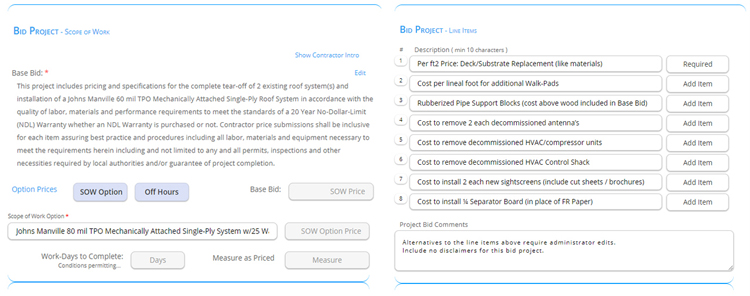
eScope Commercial
eScope Commercial
Digital Construction Bid Submission
CaPSCi Enabled!
