
How to Plan, Bid &
Analyze Roofing Cost
What Consumers Need to Know
The difference between roofing quotes can be twice the lowest price making timing, vendor and product matching critical to the analysis of contractor rates.
Timing your RFQ and Installation Dates
Planning roof upgrades at the end of year provides considerable advantages to pricing, prep-time and scheduling.
As favorable weather subsides in the fall roofing contractors are forced to moderate active projects and look towards scheduling work in the spring. Suppliers also face the seasonal demands of roofing and challenges planning inventory requirements. Combined they provide an incentive to offer and guarantee favorable rates ahead of the new year.
It can take four to six months to plan and start a commercial roof installation. Starting the bid process in October provides enough time to review material options and rates, select a contractor, negotiate configuration options and pricing and sign contracts.
Contractors require the latter to establish and schedule project manpower and resources for the installation. Generally we work around tenant activities but owners are best advised to schedule installation of most roof types in the best weather (60° to 80°).
Commercial property owners and management should also consider how the building and roof size will affect duration of installation. On average the time to install waterproofing on a commercial property starts at six to eight weeks. Large and complicated roofs can require five or six months and any number of unknown variables can delay a roofing project.
Schedule the start of a roof installation with enough time to complete the project by mid-October (or earlier in northern states). Upgrading a large roof should start no later than May unless the contractor can dedicate enough manpower to guarantee completion by fall.
Bidding Projects
Randomly requesting quotes provides obvious information for budget and planning purposes but often requires each contractor define their own recommended deliverable. The result is individual contractors pricing different waterproofing system configurations and rates that may appear low but are not the best for that roof system.
It’s not unusual to provide contractors with a system outline to quote but components contractors include can be entirely different. A single word in a roof system description or perceived value of a warranty can represent a significant technical consideration that impacts the expected deliverable.
Committing a roofing project to bid assures contractors price the exact same deliverables on common terms. Bidding construction is not much different than technology – it’s technically complicated. A roofing bid specification is nothing more than a detailed description with technical references that outline a binding deliverable until altered by disclaimers and rewrites.
The scope of work (SOW) outlines approved brands, how products are to be configured and in roofing the method(s) of installation. In build, it’s best to price the SOW separate from unrelated works, configuration options and potential change orders.
The objective in bidding is to compare contractor price rates based on a standard of performance. Bidding may also define how contractors present rates to simplify analysis, identify variants and configure project expense.
A roofing scope includes a manufacture, brand and type of material and no dollar limit (NDL) warranty term. Using the NDL reference is a simplified statement of contractor, material and installation performance requirements. It’s also an easy to understand reference to complicated roof configurations.
The required components of any roof system are uniquely different between various manufactures and even brands of the same producer. No dollar limit warranties outline what components (like insulation) are required by the manufacturer to qualify for an extended guarantee from that manufacturer.
Wood and concrete decks influence the method of installation and most commercial property owners follow regulations to define the type of project as an overlay or tear-off. States similar to California have the alternative to an overlay in resurfacing. Certain existing roofs can be upgraded with a reinforced fluid applied acrylic system.
Also ask roofers to include the number of workdays they expect the project to last. Divide that by five to get the number of weeks it will take to complete the installation.
Analyzing Price Quotes
The complexity of roofing systems and loosely defined requests for quote (RFQ) can be confusing to consumers. System configurations intended to reduce cost inevitably affect the quality and sustainability of the buildings waterproofing.
According to industry reports, roof system life-cycles in the U.S. last just under seventeen years. The average serviceable life of a 20 year roof system in the U.S. is 17 years. And its not unusual for a roof to last under 16 years in sunbelt states where excessive sun deteriorates roofing faster.
Inconsistent price quotes confuse consumers said Anthony de Kerf, author of Structured Pricing. When technologies are too difficult to compare objectively, buyers fall back on price as the deciding factor.
Price rates on a common roofing specification generally fall within 3% to 8% of each other said Gary Davis, CIO at RFQGuides. Above this range raises concern highlighting where contractor configuration variables affected their price and possibly the quality of deliverables.
It’s not unusual to see price differences greater than 10% between quotes. But large price variations raise questions and red flags for any type of construction job. It’s important to match the type of contractors invited to quote.
Union shops are consistently higher than independent contractors. It’s not a matter of quality or expectation of greater performance. The manpower costs at union shops are generally higher.
In complex products like roofing, significantly lower rates usually result when contractors quote different materials, system configurations or don’t understand deliverables.
Bids managed by property managers demonstrated this in three rounds of pricing between five contractors. Initial quotes could not be compared due to inconsistent configurations and price differences of $200,000 between contractors.
It followed months of confusion before CRS Roof Consultants was asked to assist. CRS qualified three contractors and ownership requested an additional vendor be included. That contractor was consistently low in previous quotes and on the CRS bid specification. Upon review, the $542,000 difference was barely enough to cover material costs.
In addition, ownership requested an additional quote from a union roofer in a no bid situation. This contractor priced the $850K project closer to $700,000 but configured two entirely different roof systems.
Unfortunately, in no bid situations it’s impossible to determine if buyers get the best price, said Kevin Cardoza a technical consultant at CRS. Admittedly this contractors’ price was substantially lower. But they replaced the waterproofing with a lower cost solution. Project success faced two immediate challenges.
The service providers’ workload and schedule delayed the project another two months. And, work didn’t start until mid fall when the material could not be installed due to cooler temperatures.
Within a month, Cardoza continued the entire project was shut down until spring. The existing roof system was half removed with only 60 out of 380 feet of new waterproofing installed.
The lowest price isn’t always the best contractor to choose, said Davis. Project scheduling can be an important factor to meet tenant expectations, funding requirements or getting the roof installed ‘before’ winter.
Property investors concerned about property valuations note the ROI of waterproofing has an immense impact on the sale of most property. A poorly installed, aged or failing roof system is one of the first things to be discounted from the sale price. Assuring integrity of new roofing improves property valuations by avoiding higher priced discounts at a future sale.
It’s also important to define best practices over generally accepted methods and techniques. This is critical to minimize tenant disruption and annual maintenance requirements. Equally, a well described labor warranty can be leveraged to improve the contractors’ attention to detail during installation.
eScope Roofing Solutions
AI Generated Scope of Work for Commercial Roofing
Autonomous Scope of Work

eScope Commercial

Line Item Pricing

Autonomous Scope of Work & Line Items
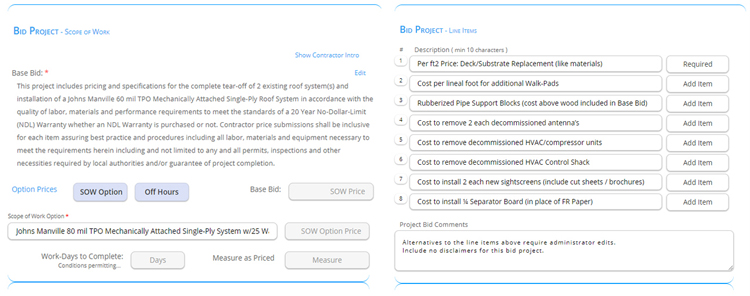
eScope Commercial
eScope Commercial
Construction Project Supply Chain Infrastructure
CaPSCi Enabled!
